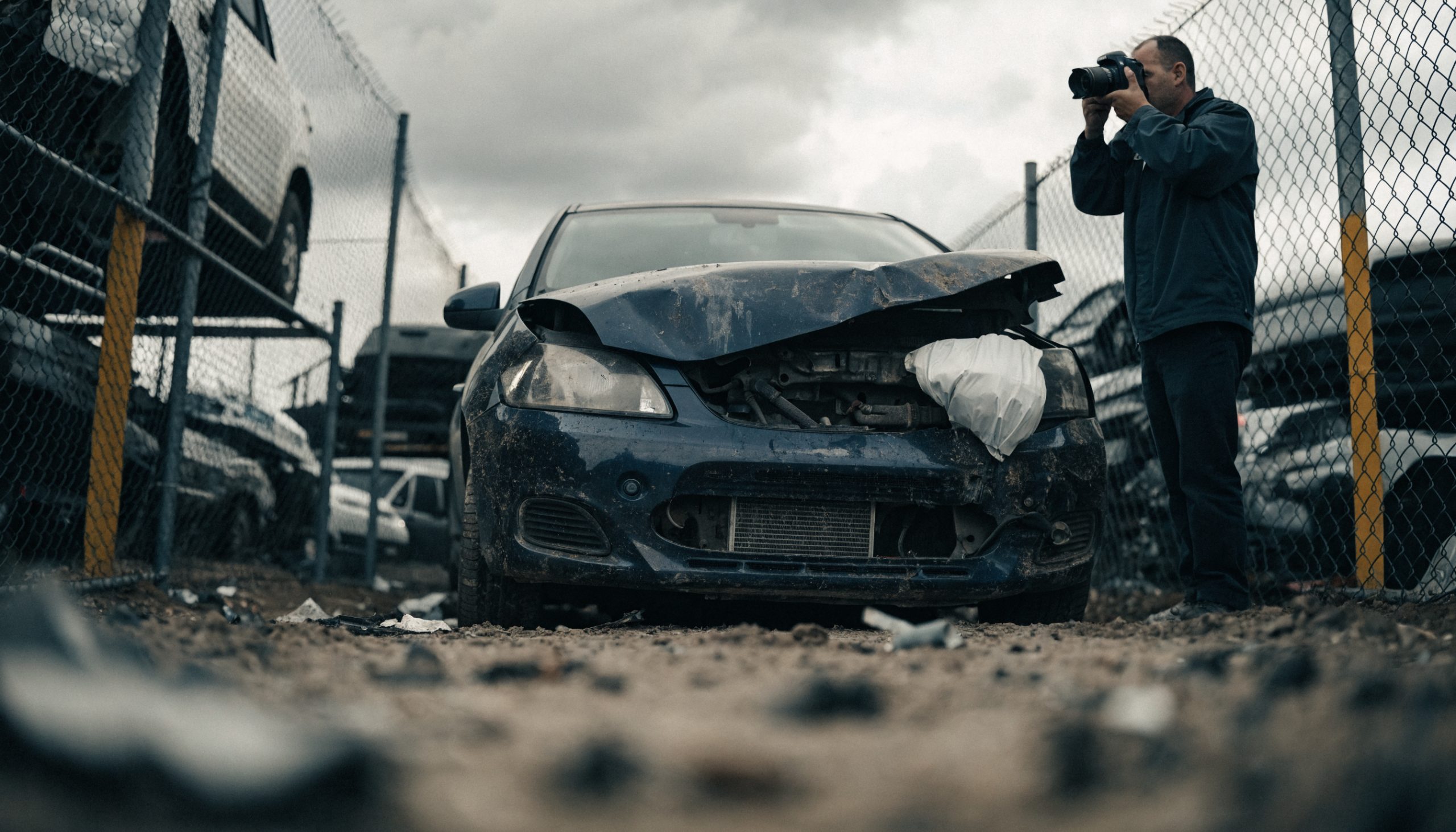
A total loss is not declared because a vehicle looks bad, but because repairing it is no longer economically justified. The decision is made by comparing two figures: the cost of repair and the value of the vehicle. That is why, in a total loss, the valuation matters just as much as the damage assessment.
What a total loss is
A total loss exists when the cost of repair reaches or exceeds a certain ratio to the value of the vehicle before the loss event. That ratio is not set arbitrarily, but according to the insurance terms and accepted practice.
Two cases are distinguished. With a technical total loss the vehicle is destroyed to the point where repair cannot be carried out. With an economic total loss repair is technically possible, but it costs more than it is worth. In practice the second case is far more common and far more disputed.
How the amount of compensation is calculated
The calculation has three elements:
- The value of the vehicle before the damage. The realistic value of that specific vehicle on the day of the event.
- The salvage value. How much the damaged vehicle, the wreck that is left, is worth.
- The compensation. The difference between those two amounts.
This shows why both figures matter. A lower established value before the damage and a higher assessed salvage value together produce lower compensation.
The value of the vehicle before the damage
This is where most misunderstandings arise. The value is not automatically equated with the catalogue amount, because the catalogue describes the model, not your particular vehicle. The actual value is affected by mileage, general condition, service history, equipment, earlier damage and demand for that model.
We explained the difference in detail in the article on the catalogue value of a vehicle. If your vehicle is well kept, serviced and free of earlier damage, it is worth more than the average for its year, and that has to be proved rather than assumed.
The salvage value
The salvage is the damaged vehicle, which is still worth something, either for its parts or because it can be repaired. Its value is established by appraisal or from offers on the market.
It is important to know that as a rule the salvage stays with you, unless something else is agreed. That means you keep the vehicle along with the compensation, so you have to decide what to do with it. If the assessed salvage value is higher than what you can actually get on the market, you bear that loss.
Partial damage that comes close to the threshold
There is a zone in which the cost of repair has not yet crossed the threshold but is close to it. There the decision can go either way, depending on how the individual elements have been assessed.
If the repair falls within that zone, pay attention to whether the calculation includes operations that are not necessary, or whether some parts are scheduled for replacement even though they can be repaired. An exaggerated cost of repair can push a vehicle into a total loss it does not deserve, and the owner then loses a vehicle that could have been repaired.
Hidden damage and how it affects the decision
With heavier impacts, part of the damage cannot be seen until the vehicle is dismantled. Deformation of the load bearing structure, damage to the cooling system, the steering mechanism or the electronics can significantly change the calculation.
That is why it is important for the damage record to state expressly that hidden damage is possible. If it is discovered later and was not mentioned, having it recognised after the event is harder.
Electric and hybrid vehicles
With electric vehicles the calculation often turns on the battery pack. The battery is the most expensive single component, so damage affecting it quickly leads to a total loss, even though the rest of the vehicle is relatively intact.
Assessing these vehicles calls for knowledge of the specific features of the drivetrain and of battery state diagnostics, because the degree of damage cannot be established visually.
What if the event itself is disputed
Sometimes it is not only the amount that is disputed, but also whether the damage arose in the reported event at all. In that case an analysis of damage compatibility is carried out, comparing the traces on the vehicles, the heights and directions of the deformation and the described course of events.
That is the work of an expert report on a traffic accident, not of an ordinary damage assessment. With larger amounts and disputed circumstances, that analysis often decides the whole case.
When it is worth contesting the calculation
Contesting makes sense when there is a specific reason, not merely dissatisfaction with the amount:
- The value of the vehicle before the damage has been established lower than it really is
- The salvage value has been assessed higher than can be achieved
- The cost of repair has been exaggerated, so the damage has been declared a total loss unnecessarily
- Investments made in the vehicle and additional equipment have not been taken into account
- Not everything you are entitled to has been calculated, for example towing and storage costs
In all of these cases an independent report is needed that explains both sides of the calculation, the value and the damage.
What happens to the vehicle afterwards
If you keep the salvage, you have several routes: selling it as it stands, selling it for parts, or repairing it at your own expense. Each has a different calculation, and the decision depends on how much the salvage is really worth.
If the vehicle was on a lease or part of a fleet, the procedure is more complex because the owner also takes part in the decision. For companies we run that process through our fleet assistance service.
For a vehicle valuation or an independent report contact us.
Frequently asked questions
When is damage declared a total loss?
When the cost of repair exceeds a certain percentage of the value of the vehicle before the accident, or when repair is not technically justified. The threshold is not the same at every company and is laid down in the insurance terms, so it is worth checking it in the policy.
Who keeps the wreck and how is it calculated?
Most often the owner keeps it, and the salvage value is deducted from the compensation. That value is often disputed, because it is assessed rather than obtained from the market. If the salvage value is overestimated, you receive less than you are entitled to.
Can I contest a total loss calculation?
You can, and in two places: on the value of the vehicle before the accident and on the salvage value. Both are established by appraisal, so both can be reviewed with an independent report setting out a reasoned methodology and comparable market data.